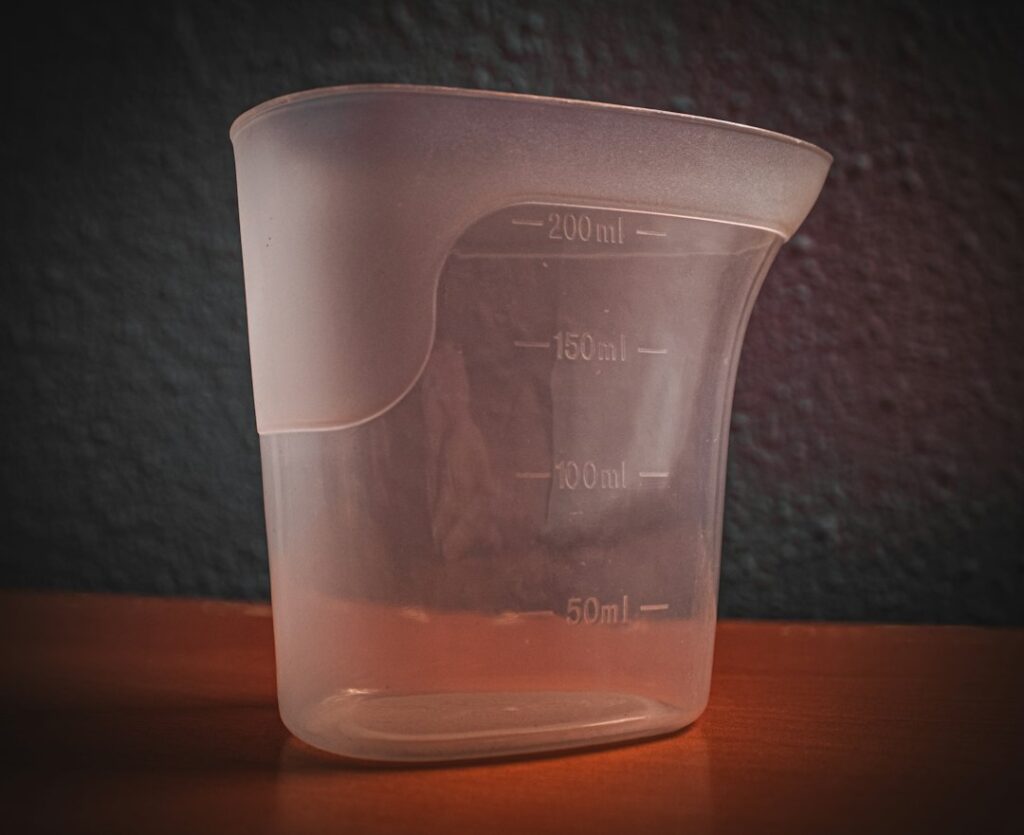

Next, place the cup on a level surface and read the liquid at eye height. Most water-like liquids form a curved surface called a meniscus. For routine volume work, read the bottom of that curve against the scale rather than viewing from above or below. A tilted cup can make the level appear higher or lower than it is. If you are comparing models, a liquid measurement cup with clear, well-spaced markings is easier to use repeatedly than one with crowded lines. This simple viewing habit improves consistency without requiring specialized equipment.
Consider the liquid itself before selecting capacity or material. Viscosity describes how readily a liquid flows. Water moves quickly, while syrup, oil, and some chemical concentrates cling to the walls and may need extra draining time. Surface tension can also leave a bead around the rim, so avoid stopping the pour before the liquid settles. Material compatibility is another technical concept in plain terms: the cup must resist softening, cracking, clouding, or absorbing the substances it holds. For household ingredients, a food-safe vessel may be appropriate; for industrial chemicals, follow the supplier’s handling guidance.
Spill control matters when a cup travels from a storage container to a mixer or application tool. Look for a stable base, a comfortable grip, and a spout that directs the stream rather than letting it run down the outside. A shaped pitcher can be especially useful for larger volumes because the handle keeps fingers away from the liquid and supports a controlled pour. For example, a janitorial worker preparing a floor solution may reduce splashing by filling slowly and using a spout over the bucket’s center. The right geometry helps protect the work area and preserves the intended ratio.
Capacity should reflect both the normal batch and the consequences of an error. A four-ounce measure can provide closer control for small additions, whereas a one- or two-liter pitcher may be more practical for repeated batch preparation. Do not assume a larger cup is automatically more accurate at small volumes, because its markings may be farther apart. Conversely, a tiny cup may require several pours for a large batch, creating more opportunities for spills and missed quantities. A useful test is to mark the volume you use most and confirm that it falls between clearly readable graduations.
Before putting a new cup into daily service, run a simple verification. Fill it with water to a marked line, check the level at eye height, and compare the result with a known measuring vessel if one is available. This is a practical check, not a formal calibration certificate. Calibration means comparing an instrument with a recognized reference and documenting how closely it agrees. Also inspect the rim, handle, spout, and markings for damage. If the scale has faded or the vessel has warped, retire it from precision work. Clean according to the material’s guidance and store it where the markings remain visible.
Finally, match the cup to the workflow rather than treating it as a generic container. A production area may need several capacities, dedicated vessels for incompatible materials, and labeling that prevents accidental substitution. A restaurant prep station may prioritize food-safe construction and quick washing, while a maintenance team may prioritize chemical resistance and splash reduction. For broader product-selection considerations, consult measuring pitcher guidance. Ask whether the scale is readable, the capacity fits the batch, the material suits the liquid, and the handle and spout support a steady pour. Those answers lead to safer, repeatable measurements.